
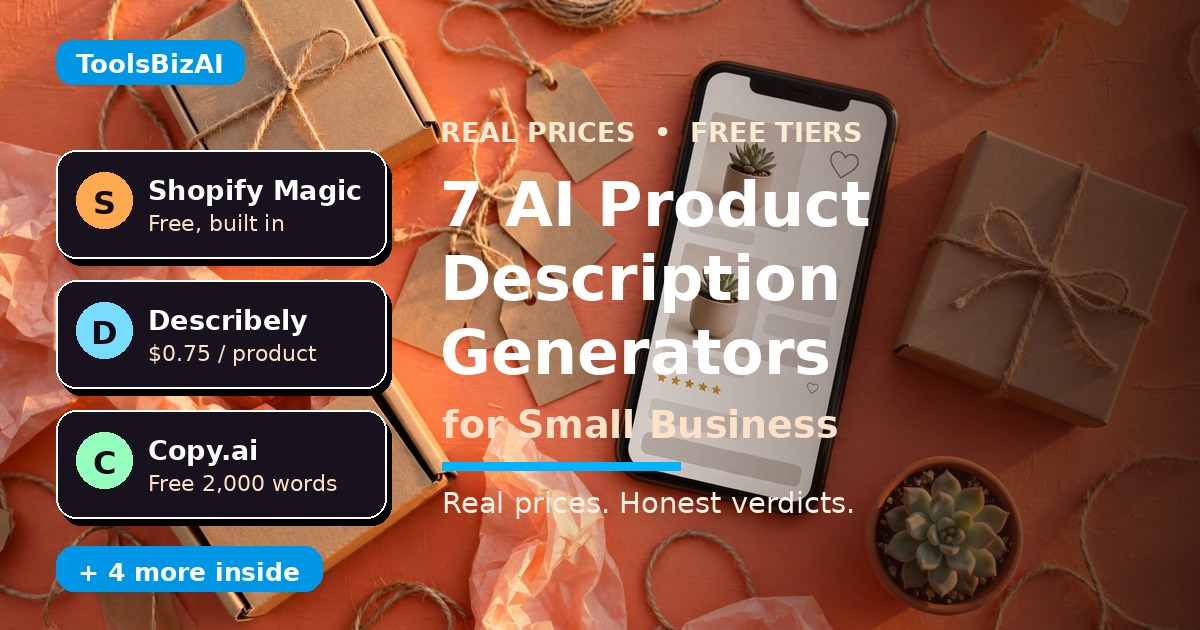
Every online seller knows this scene: new products arrive, photos done, every description box blank. You write three, they all sound the same, and soon you’re typing “high quality, durable, great gift” on autopilot.
The best AI product description generators for small businesses turn your rough product notes — name, features, who it’s for — into finished, benefit-led listing copy in seconds. For most small businesses the right setup costs $0–$29 a month: Shopify Magic is free on any Shopify plan, Describely charges $0.75 per product with no subscription, and its first 5 products are free.
In this guide: all 7 tools with real October 2026 prices, which free tiers produce usable copy, which tools handle bulk catalogs (CSV in, descriptions out), platform picks for Shopify, WooCommerce, and Etsy, a side-by-side pricing table, my worth-it-or-skip-it verdict on each, and whether AI-written descriptions hurt your SEO.
TL;DR — the short version
- Best for Shopify stores: Shopify Magic — free, built into your admin, generates a description from keywords in one click. Start here and pay for nothing.
- Best dedicated tool: Describely — built only for product copy, pay-as-you-go at $0.75 per product, bulk generation with direct Shopify and WooCommerce sync.
- Best free starting point: there isn’t one among the generalists anymore — Copy.ai’s free tier is gone from its pricing page and Writesonic’s cheapest plan is now $99/mo (both verified today). For $0, use Shopify Magic on Shopify or Describely’s first 5 free products.
- The one that failed: aididitforyou.com’s free generator — Google’s #1 result for this keyword. The form asks for no login, but generation failed on all 3 of my attempts. Included below as a cautionary tale.
- Skip for most: Jasper ($69/mo Pro — overkill here), Writesonic ($99/mo Starter — the budget pick that isn’t), and Hypotenuse AI (custom-quoted, no public prices).
How we checked these tools
On October 17, 2026, I opened all 7 official websites and read every pricing page. I also ran the top-ranked free generator for real — it failed three times, and that failure is in the list below. I did not buy paid plans; verdicts rest on verified pricing, free-tier limits, bulk-workflow depth, and platform fit. Where a price sits behind a sign-in wall, I say “could not verify.”
The 7 tools side by side
| Tool | Cheapest way in | Free tier | Bulk generation | Best for | |
|---|---|---|---|---|---|
| Shopify Magic | Free (needs a Shopify plan) | Yes — unlimited text generation | No (one product at a time) | Shopify stores, obviously | |
| Describely | First 5 products free | Yes — first 5 free, no card | Yes — CSV + direct store sync | Catalogs of 20+ products | |
| Hypotenuse AI | Custom quote | Free trial; no public price | Yes | Mid-size catalogs, brand voice | |
| Copy.ai | $29/mo Chat | None found (Oct 2026) | Trial only | No (template-based) | None at this price |
| Writesonic | $99/mo Starter | Trial only | No (template-based) | None at this price | |
| Jasper | $69/mo Pro (7-day trial) | No | Via campaigns (team plans) | Teams needing brand control | |
| aididitforyou generator | Free | Form needs no signup; generation failed 3/3 | No | None — broken Oct 2026 |
Prices verified on the official sites, October 17, 2026.
The 7 tools, checked one by one
1. Shopify Magic — the free default for Shopify stores (WORTH IT)
If you sell on Shopify, open your own admin before reading another listicle. Shopify Magic is Shopify’s built-in AI: on any product page, click the Generate text icon in the description toolbar, type your prompt, and it drafts the copy right in the field. Free on every Shopify plan, no usage meter documented, works in every language Shopify supports.
Give it specifics (“hand-poured soy candle, cedarwood and vanilla, 8oz, gift buyers, warm premium tone”) and you get a workable draft; give it “write a description for a candle” and you get filler — Shopify’s own doc says the same: more detail in, better draft out. Two honest limits: one product at a time (no bulk runs), and the output usually needs a brand-voice pass.
Verdict: WORTH IT. It’s free, it’s already in your store, and it handles the “I need ten descriptions by Friday” week on its own. Only look at the paid tools below when your catalog outgrows one-at-a-time generation. Official docs: Shopify’s guide to generating product descriptions.
2. Describely — the specialist I’d pay for (WORTH IT)
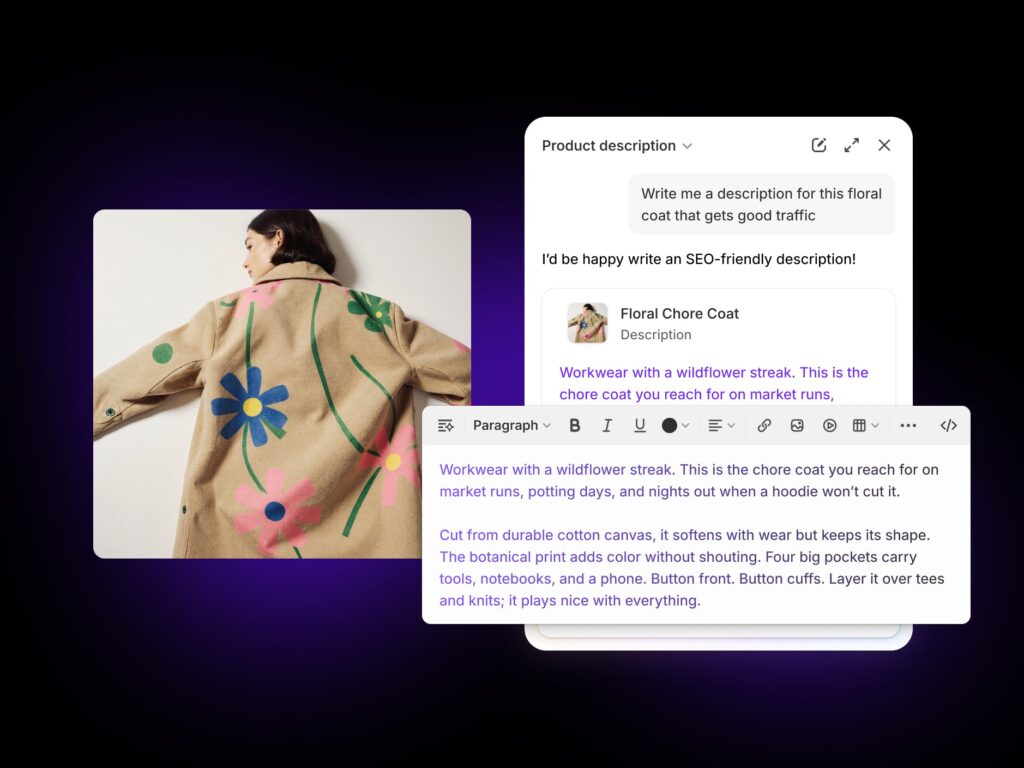
Describely does one thing — ecommerce product content — and the focus shows. Connect your Shopify or WooCommerce store (or upload a CSV), and it pulls your product data, generates descriptions in bulk, and pushes them back — meta titles and descriptions included, which every generalist tool here makes you do separately. Its standout trick is data enrichment: missing supplier attributes get filled from web sources before writing, so thin spreadsheets still produce accurate descriptions.
Pricing is refreshingly small-business-shaped. Your first 5 products are free (no credit card), which is enough to evaluate it properly. Then it’s pure pay-as-you-go at $0.75 per product — unlimited generations per product, data enrichment at $0.55 a credit if your supplier data is thin — so a 40-product catalog costs $30 once, not monthly. There’s no monthly subscription at all; the only other tier is custom-priced “High volume” for 500+ SKUs. The catch: it’s built for volume. If you need two descriptions a month, use Shopify Magic or the free generator in section 7 instead — and technically complex products still need a human review pass.
Verdict: WORTH IT for stores with 20+ products or messy supplier data. The pay-as-you-go model is the fairest pricing on this list. Official site: describely.ai.
3. Hypotenuse AI — capable, but priced for bigger catalogs (SKIP for small stores)
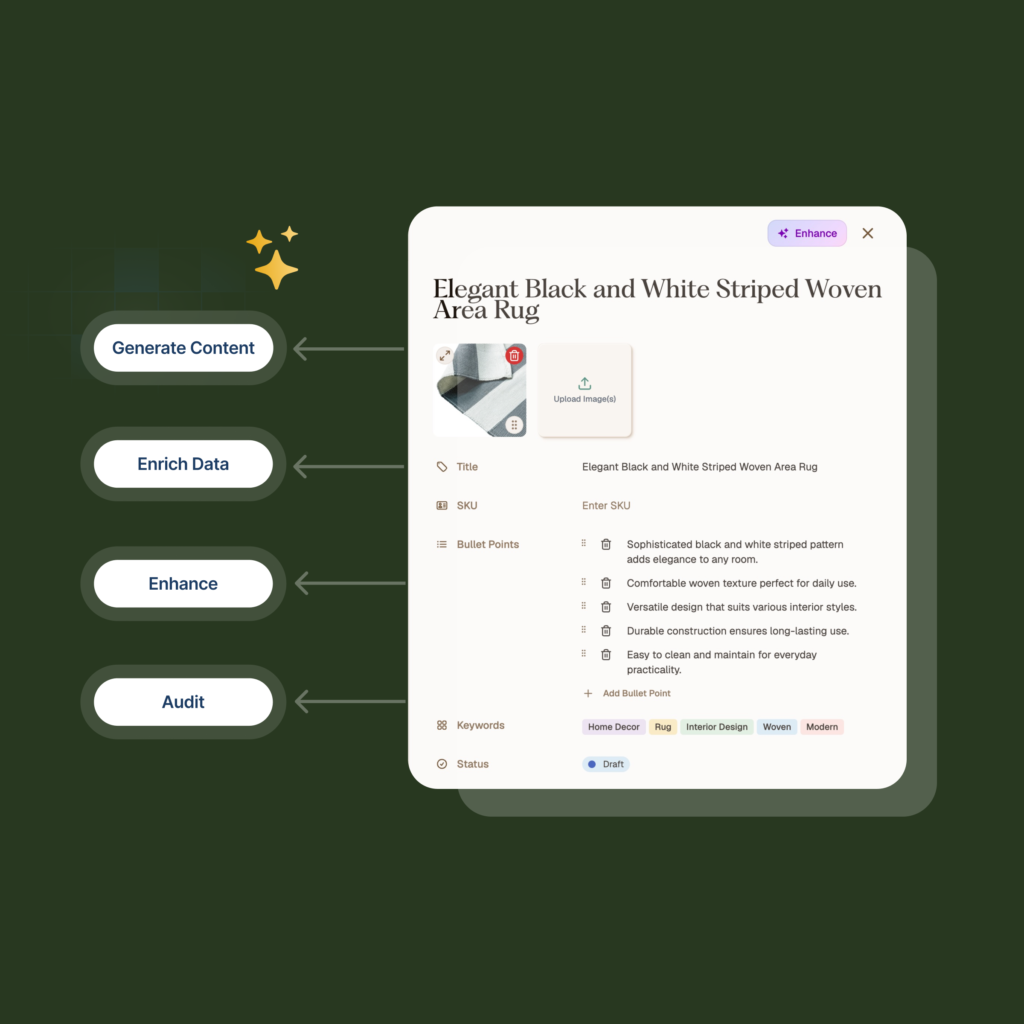
Hypotenuse AI is a Y Combinator-backed platform with serious ecommerce features: bulk generation, brand voice training, data enrichment, AI tagging, 30+ languages, and Shopify/WooCommerce/Amazon integrations. On paper, the most complete catalog machine here.
The problem is the price tag — or rather, the lack of one. When I opened hypotenuse.ai/pricing on October 17, 2026, both plans (Basic and Ecommerce Enterprise) were priced “Custom,” with no monthly prices published at all. The Basic plan offers a free trial, but the moment you want to pay, you’re in quote territory. For a small business, “custom pricing” is usually code for “more than you want to spend”: Describely publishes $0.75 per product, Shopify Magic is free, and Hypotenuse won’t tell you its price without a sales conversation.
Verdict: SKIP for most small businesses. Shortlist it when you’re generating hundreds of descriptions monthly. Official site: hypotenuse.ai.
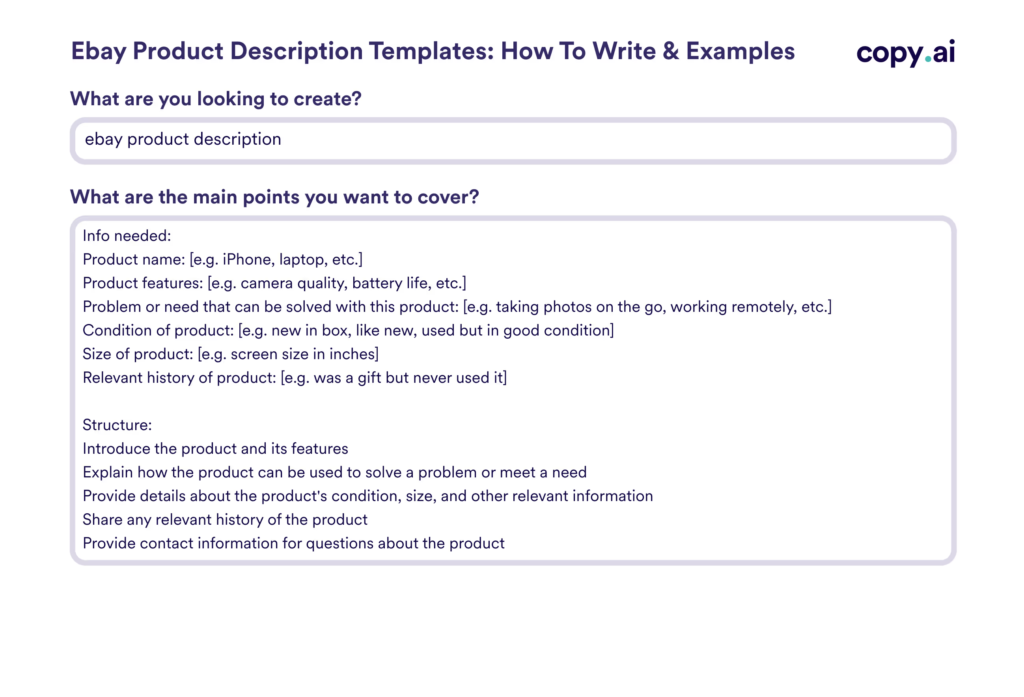
4. Copy.ai — the free tier vanished from its pricing page (WORTH IT with a caveat)
Copy.ai used to have the most generous free tier among generalist writers — 2,000 words a month, no credit card — and October 2026 reviews still describe it. I write “used to” deliberately: on October 17, 2026, copy.ai/prices listed no free plan anywhere. The only self-serve option is Chat at $29 a month ($24 on annual billing: 5 seats, unlimited chat words), plus custom-priced Enterprise. I signed up via Google (no card) to check — the new account landed on an “Upgrade Your Plan” screen with no free tier in sight.
What remains is capable: unlimited chat words, tone presets, 90+ templates including product descriptions. But at $29 a month with no free on-ramp, Describely’s pay-as-you-go does the same job cheaper for descriptions specifically.
Verdict: WORTH IT only if you also want it for other marketing copy. As a descriptions-only buy, the cheaper options above win. Official site: copy.ai.
5. Writesonic — the budget pick that isn’t anymore (SKIP)
Writesonic used to be the value play — reviews from weeks ago list a $16-a-month plan and a free tier. But writesonic.com/pricing on October 17, 2026, tells a different story: Starter at $99 a month ($79 annual), Basic $249, Growth $499, Enterprise custom. No free plan — just a “start free” trial with limited runs. The company repositioned as an “AI search growth engine,” and the pricing followed.
That kills it for this job: at $99 a month, Writesonic now costs more than Jasper’s $69 Pro — the tool it used to undercut several times over. Nothing about product descriptions needs a $99-a-month growth engine.
Verdict: SKIP. The budget era is over. Official site: writesonic.com.

6. Jasper — excellent writer, wrong price for this job (SKIP)
Fairness first: Jasper has the best pure writing quality here and the strongest brand-voice training — feed it your copy and everything sounds like you, consistently, across a team. For a marketing team producing at volume, that system earns its price.
But we’re talking about product descriptions for a small business, and the math doesn’t work. Jasper’s entry plan is Pro at $69 a month per seat ($59 billed annually), there is no free plan — only a 7-day trial — and the old $49 Creator tier is gone. That’s $828 a year for a job Shopify Magic does free and Describely does for pocket change. Unless your whole content operation already runs on Jasper, this is the most expensive way to fill in description boxes.
Verdict: SKIP for product descriptions specifically. Revisit only if your whole content operation already runs on Jasper. Official site: jasper.ai.
7. The free no-signup generator Google ranks #1 — it didn’t work (FAILED TEST)
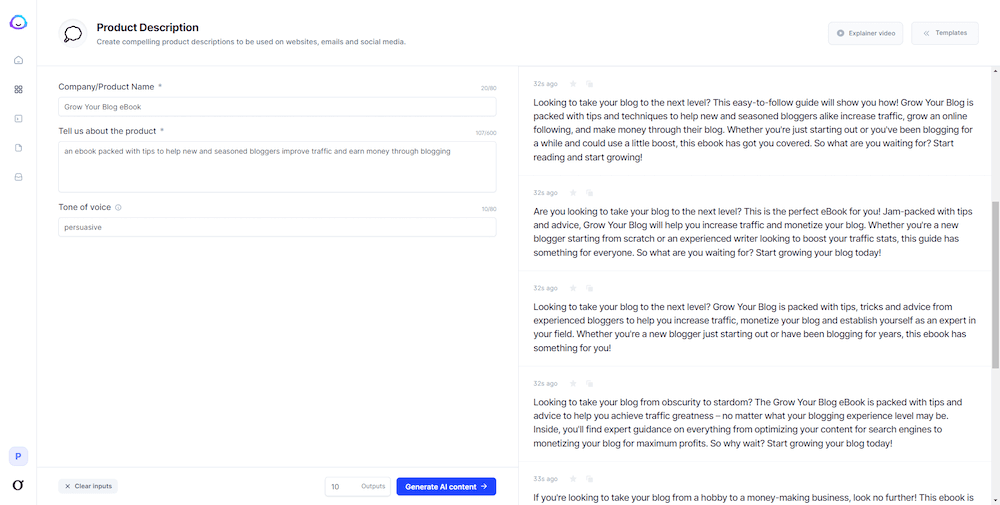
This is the one I most wanted to work. The free generator at aididitforyou.com currently holds the #1 Google result for this keyword, advertises “Free · No login,” and the form genuinely asks for nothing — I filled it with a sample product (hand-poured soy candle, cedarwood and vanilla, 8oz, gift buyers, Etsy, Persuasive tone) with zero friction.
Then I clicked “Write my description” — and got “Something went wrong. Please try again in a moment.” I tried three times, including after a full page reload. Same error every time; no description was ever generated. The tool may be temporarily down or permanently broken. Either way, on October 17, 2026, the top-ranked free generator for this keyword did not generate anything.
I’m including this failed test on purpose. Most roundups would quietly drop a tool that didn’t work and pretend the list was always six. You deserve to know the #1 result failed when tested — and to be skeptical of any review that recommends a tool without evidence it ran.
Verdict: SKIP for now. The form asks for nothing, so there’s nothing to lose by checking back later. But don’t build a workflow around it until it actually generates. The page: aididitforyou.com’s free generator.

The bulk workflow: 200 products, one afternoon
When one-at-a-time generation would take weeks, here’s the workflow that works:
- Export your product data to CSV — name, SKU, features, materials, dimensions. Most platforms export this natively; cleaner input means better output from every tool.
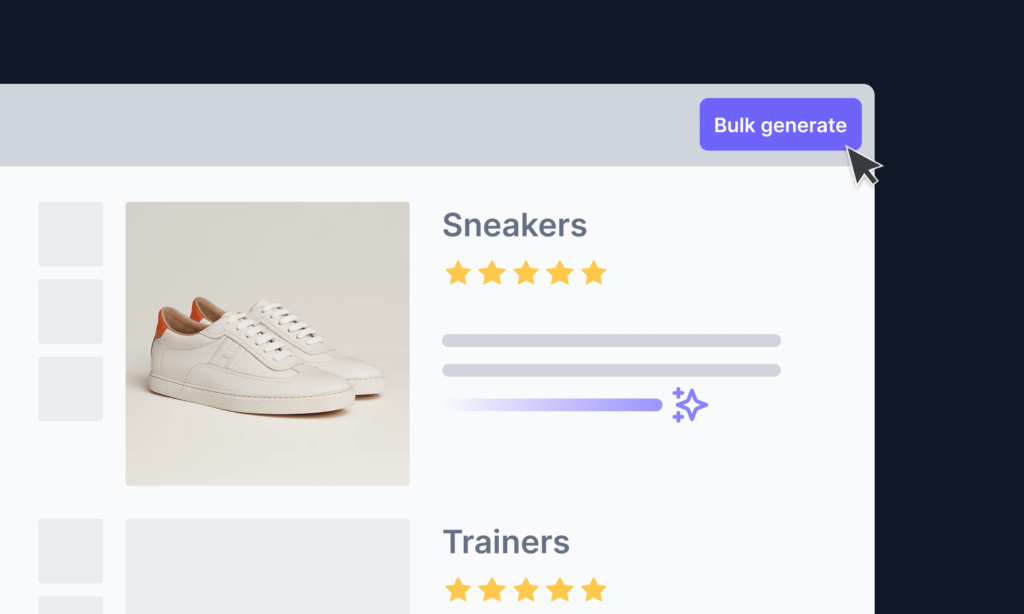
- Generate in bulk with Describely (or Hypotenuse at enterprise scale). Upload the CSV, set tone and content rules once, run the whole catalog — under 100 products typically takes an afternoon, most of it waiting.
- Spot-check 10% by hand. Read every tenth description fully. AI states invented facts with total confidence — dimensions, materials, “handmade” claims. If your data was thin, this is where enrichment gaps show up.
- Push back to your store via the direct integration, then hand-write meta descriptions for your top 20 products by traffic — that’s where the SEO value concentrates.
Total cost for a 200-product catalog on pay-as-you-go: $150, once. A freelance copywriter would charge $20–50 per description — $4,000 to $10,000 for the same catalog. That’s the ROI case in one paragraph.
Platform picks: Shopify vs WooCommerce vs Etsy
On Shopify: start with Shopify Magic (free, zero setup). Graduate to Describely when you need bulk runs or your descriptions drift off-brand across product lines.
On WooCommerce: there’s no built-in Magic equivalent — Describely’s WooCommerce integration is the closest thing, with the same bulk workflow and direct sync back to your store.
On Etsy: listings live or die on titles and tags, not just descriptions — Etsy’s search leans on tags heavily, so verify any AI-suggested tags against Etsy’s own search-bar autocomplete. Generate in Describely (first 5 products free) via CSV and paste into listings.
Will AI-written descriptions hurt my SEO?
Short answer: no — if the copy is good. Google’s stated position is that it rewards helpful content however it’s produced; what breaks the rules is automation used to manipulate rankings.
Three rules keep you safe: never publish unverified specs (AI invents dimensions and materials with total confidence — check every fact); don’t publish identical descriptions across products (thin duplicate content is the actual SEO risk, and it’s why bulk tools need that 10% spot-check); and add something AI can’t — a real detail about fit, feel, or use that only someone who’s held the product knows.
FAQ — AI product description generators for small businesses
What’s the best free AI product description generator for a small business?
One genuinely free option, verified: Shopify Magic if you’re on Shopify (free, built in). Describely’s first 5 products are free (no card), which covers a trial run. Two cautions from today’s checks: Copy.ai’s once-generous free plan no longer appears on its pricing page, and the top-ranked free generator at aididitforyou.com failed on all 3 of my test attempts — so don’t count on either.
How much should a small business pay for AI product descriptions?
Between $0 and $30 a month. The free options above cover most small catalogs; when you outgrow them, Describely’s pay-as-you-go ($0.75 per product, no subscription) is the cheapest honest path. Anyone quoting $69+/month for descriptions alone is selling a general writing platform.
Do I still need to edit AI-generated descriptions?
Yes — budget 2–3 minutes per description. Check every factual claim (materials, dimensions, origin), tighten the opening line, add one detail only you know about the product. The AI does 80%; your 20% is what makes it accurate and yours. Never publish AI copy with unverified specs.
Shopify Magic vs a dedicated tool — which is better?
Shopify Magic wins for one-offs: free, instant, already in your admin. A dedicated tool like Describely wins at 20+ products, when you need consistent brand voice across a catalog or bulk CSV workflows with direct sync. Many stores use both — Describely for catalog pushes, Magic for quick edits.
The bottom line
Product descriptions are one of the highest-ROI places to aim AI: the work is repetitive, the input data already exists, and every finished description works for you 24/7. Start free — Shopify Magic on Shopify, Describely’s 5 free products elsewhere. When one-at-a-time writing breaks down, Describely’s $0.75-per-product pricing is the honest upgrade. Skip the $69–$99/month platforms unless your whole content operation already lives there.
Descriptions are one piece of the store — see our 12 AI tools tested inside a real small ecommerce store (this post’s parent guide) for the full stack, and our AI marketing tools roundup when you’re ready to drive traffic to those listings. Here’s who we are and how we check every tool we recommend.
Enjoying ToolsBizAI guides?
Add us as a Preferred Source on Google — you'll see our latest tools and guides first in Search, Top Stories, and AI Overviews.
Get One Useful AI Tool Tip Every Week
One practical AI tool tip in your inbox every week. No spam, unsubscribe anytime.

We’re the team behind ToolsBizAI. We hands-on test AI tools for small businesses — signing up for free plans, taking real screenshots, and fact-checking every claim before publishing. Our guides cover marketing, customer support, and day-to-day operations.