
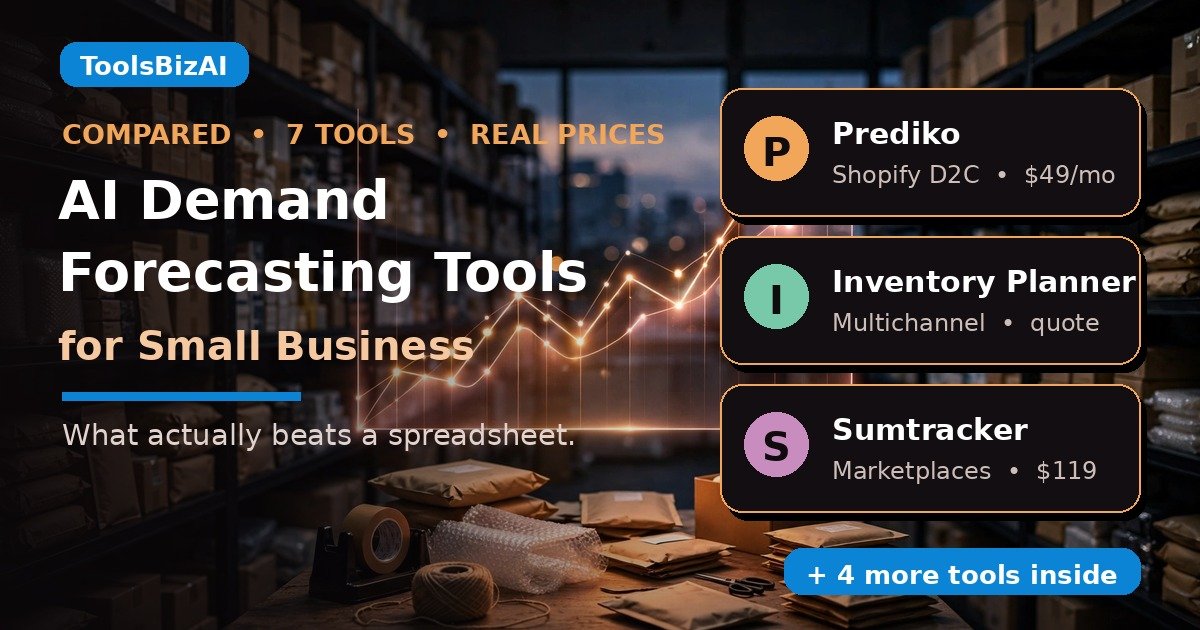
AI demand forecasting tools for small business: what actually beats a spreadsheet?
AI demand forecasting tools for small business predict how much of each product you’ll sell, then turn that into reorder dates and purchase orders. For most small sellers, Prediko (from $49/month, Shopify-only) or Sumtracker (from $119/month, multichannel) are the sensible starting points — but no tool beats a spreadsheet until it has two to three months of your sales data.
Why now? Black Friday lands on 27 November, and Constant Contact’s holiday report (3 November 2026) found 68.2% of small businesses plan to use AI this holiday season, with 30.9% using it to forecast inventory demand. TL;DR: Shopify-only — Prediko, from $49/month. Multichannel — Sumtracker Replenish, from $119/month. Big multichannel catalogue — Inventory Planner by Sage, quote-based. ERP distributor — Netstock, from $900/month. Makers — StockTrim, from $49/month annual. Pre-orders — Fabrikatör, from $99/month.
In this guide you’ll find: what these tools do; whether you need one; all 7 compared on verified November 2026 prices; a forecast-vs-spreadsheet test; matched picks by shop type; and a 6-question FAQ.
How we tested: On 19 November 2026 I opened and read each tool’s official homepage and pricing page, then cross-checked prices and ratings. What I did NOT do: run paid trials, or a same-data accuracy test — nobody can do that honestly without your sales history. Where a number is the vendor’s own claim (like “95% accuracy”), I say so.
What is AI demand forecasting, and how is it different from a spreadsheet?
A demand forecasting tool looks at your sales history — every SKU, every variant, every channel — finds the patterns (seasonality, trend, which products move together), and projects them forward. The useful ones turn the forecast into a reorder date, a suggested quantity, a draft purchase order, a safety-stock level.
Your spreadsheet can do the first half. A TREND function and a moving average go surprisingly far with stable products. What a spreadsheet can’t do is update 800 SKUs daily or know that last year’s Black Friday numbers mislead because you were out of stock for half of it. The “AI” part is mostly machine learning picking a forecasting method per item instead of one formula for everything.
Do you actually need AI forecasting, or is your spreadsheet fine?
You probably need a tool if three or more of these are true: you manage 500+ SKUs; you spend more than a day a week updating forecasts and orders; you sell across 3+ channels with stock counts in different systems; stockouts or overstock regularly cost $500–$1,000 a month.
Your spreadsheet is probably fine with under 100–200 SKUs, one channel, and seasonal patterns you understand. Forecasting errors are often put at 2–5% of revenue a year — at $100K that’s $2,000–$5,000.
The 7 tools at a glance
| Tool | Best for | Forecasting entry price | Priced by | Trial |
|---|---|---|---|---|
| Prediko | Shopify D2C brands | $49/mo ($42 annual) | Annual GMV | 14 days |
| Inventory Planner | Multichannel, $1M+ | Quote (Essentials $119.99/mo) | Inventory volume | 14 days |
| Sumtracker | Multichannel sellers | $119/mo ($100 annual) | Annual orders | 14 days |
| Netstock | ERP distributors | $900/mo | Bundle, annual | Demo only |
| StockTrim | Makers, manufacturers | $49/mo (annual billing) | Annual revenue | 14 days |
| Fabrikatör | Pre-orders, bundles | $99/mo ($79 annual) | Annual revenue | 14 days |
| GMDH Streamline | ERP distributors | Quote only | Custom | Free version |
1. Prediko — best for Shopify-only brands
Verdict: worth it. If you sell on Shopify and nowhere else, start here — the cheapest real forecasting on this list, with a 14-day trial and no credit card required.
Prediko pulls sales data straight from Shopify, builds 12-month demand forecasts per SKU, and turns them into reorder suggestions and purchase orders. It also handles raw materials and bills of materials (a $20/month add-on) — handy if you make what you sell.
Pricing runs by trailing-12-month GMV: $49/month under $100K, $119 up to $500K, $199 up to $2M, $349 up to $5M. Annual billing saves ~15%. The catch is lock-in — no WooCommerce — and its “~95% accuracy” figure is the vendor’s own claim. The 4.9/5 rating (260 ratings) is the more useful signal.
Best for: Shopify D2C brands under $2M. Skip it if: you sell on WooCommerce.

2. Inventory Planner by Sage — best for multichannel brands doing $1M+
Verdict: worth it — but only once you’re big enough to need it. The oldest tool here (on the Shopify App Store since January 2013, now part of Sage).
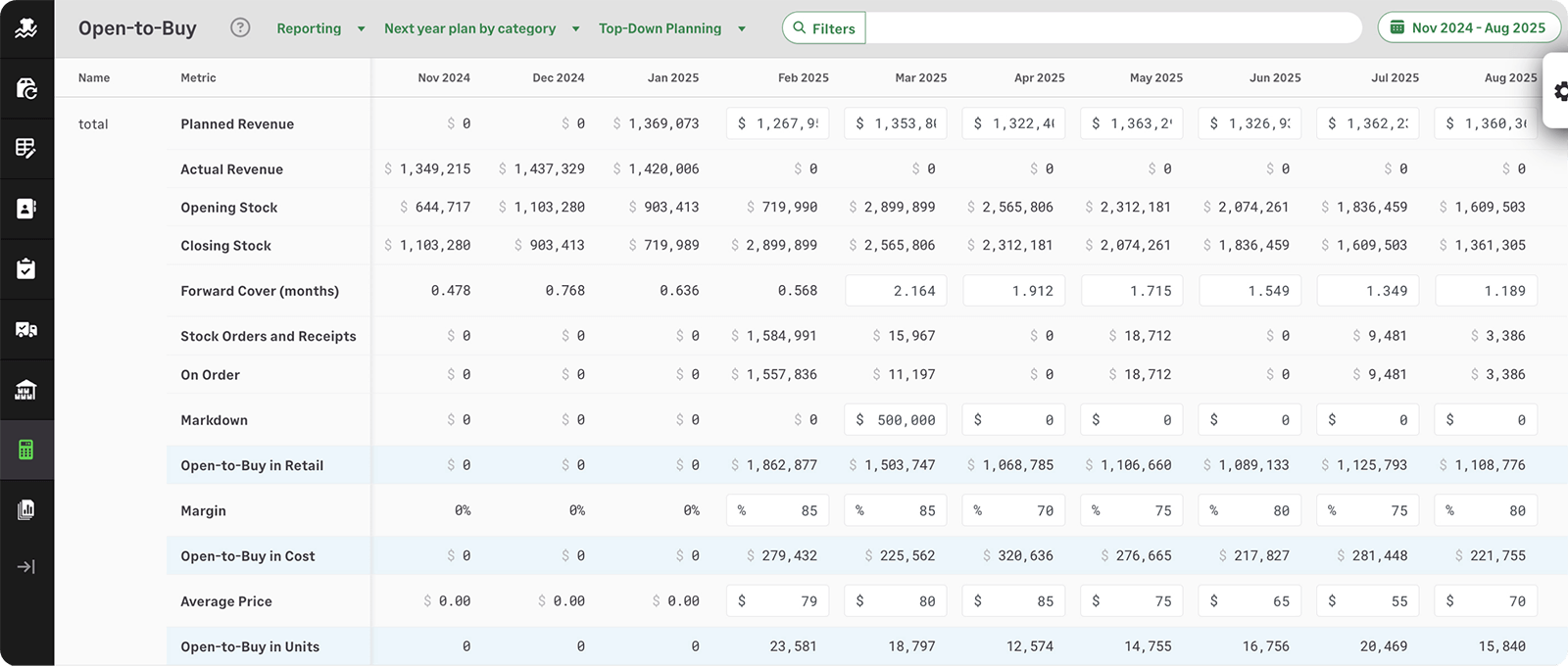
It forecasts demand SKU by SKU across Shopify, WooCommerce, Amazon, eBay and BigCommerce, then turns the forecast into replenishment and purchase orders, plus open-to-buy planning — the buying-budget view most small tools skip. Best feature: transparent forecasting — it shows how each forecast was calculated.
Pricing is the frustration. The official page is quote-based, and the only published tier I verified from two independent sources is Essentials at $119.99/month. The 4.3/5 App Store rating (154 reviews) is the weakest here.
Best for: multichannel brands over roughly $1M a year wanting one buying plan per channel. Skip it if: you’re under $500K or Shopify-only.
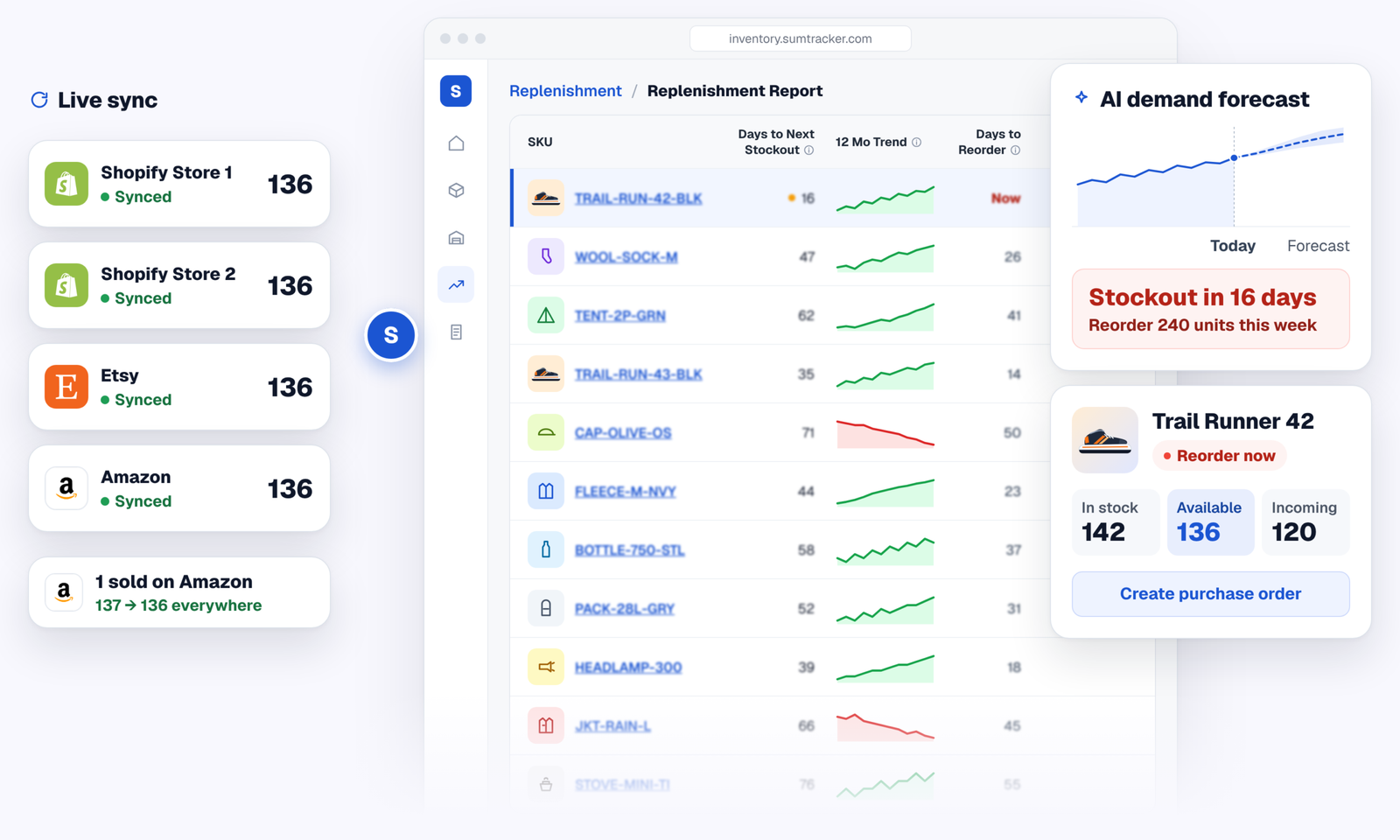
3. Sumtracker — best for multichannel sellers who keep overselling
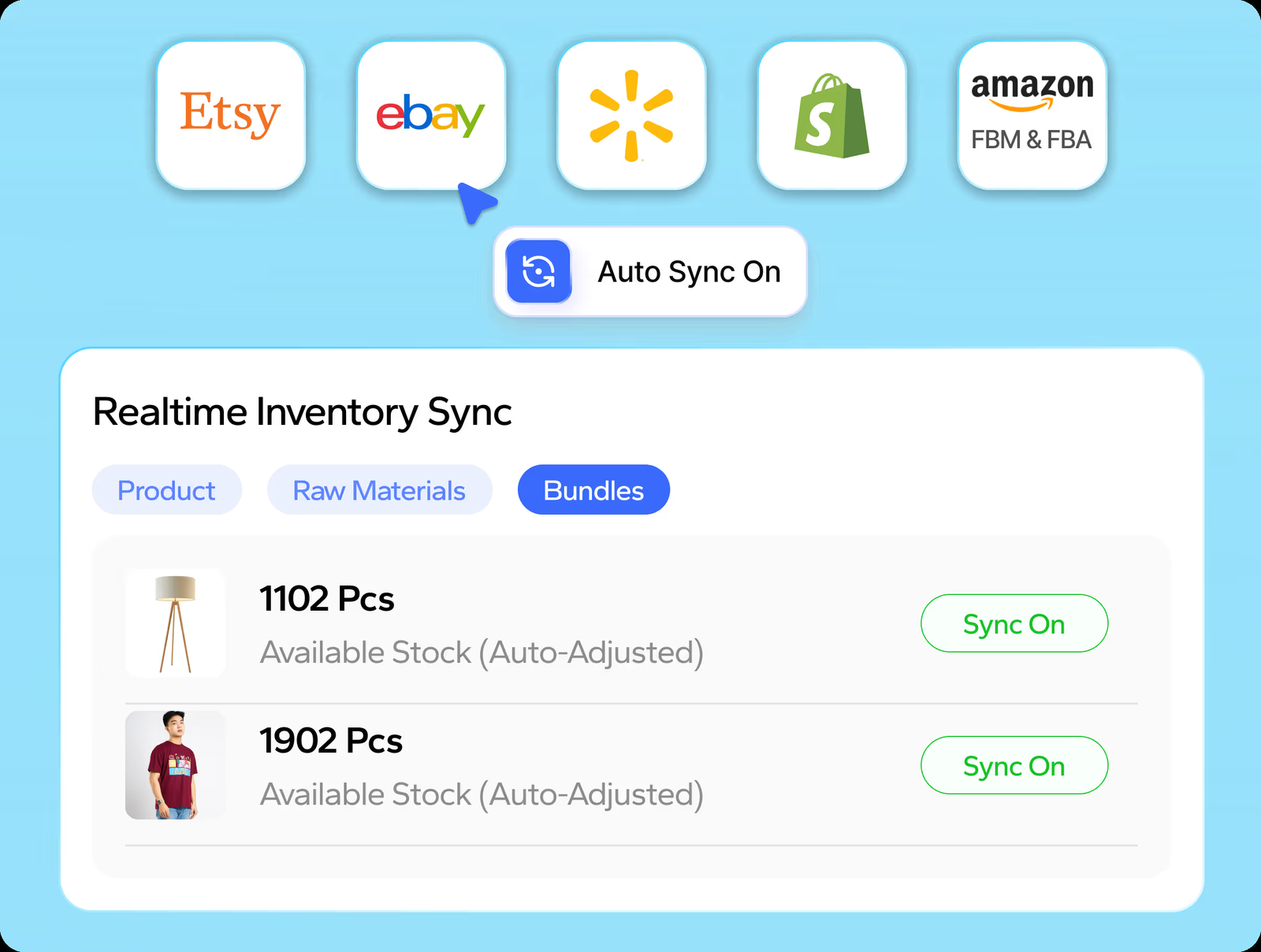
Verdict: worth it, with one trap to avoid. Sumtracker solves two problems at once: one true stock count across Shopify, Amazon, eBay, Etsy and Walmart, with forecasting on top.
The trap: the $59/month Manage plan is sync only. Forecasting, purchase orders and transfers live on Replenish, from $119/month — so the real entry price for forecasting is $119, not $59. Pricing scales with annual order volume, not revenue.
The forecasting is practical: a 12-month view from your last 12 months of sales, reorder suggestions with reorder and stock-out dates, per-supplier lead times and safety days — and it’s rated 4.8 stars on Shopify (127 reviews).
Best for: sellers on two or more marketplaces whose biggest problem is overselling. Skip it if: you’re Shopify-only (Prediko is cheaper) or need production planning with full BOM costing.
4. Netstock — best for distributors already running an ERP
Verdict: skip it unless you already run an ERP. Netstock doesn’t connect to Shopify or Amazon. It sits on top of your ERP — NetSuite, Sage, SAP Business One, Microsoft Dynamics, Acumatica and 60+ others — and turns that data into forecasts, safety stock and order recommendations.
The official pricing page states a starting price of $900 a month on annual subscriptions. Implementation typically takes 6–10 weeks; there’s no free trial — a demo only. But if poor inventory decisions already cost you far more than $900 a month, the math flips: its 4.8/5 Capterra rating is the joint-highest here.
What the money buys is depth: statistical forecasting per item and location, ABC classification, supplier performance tracking, and a Demand Planning add-on for promotions and new products.
Best for: distributors and manufacturers with 250+ SKUs and an ERP in place. Skip it if: you don’t have an ERP. No ERP, no Netstock — it’s that simple.

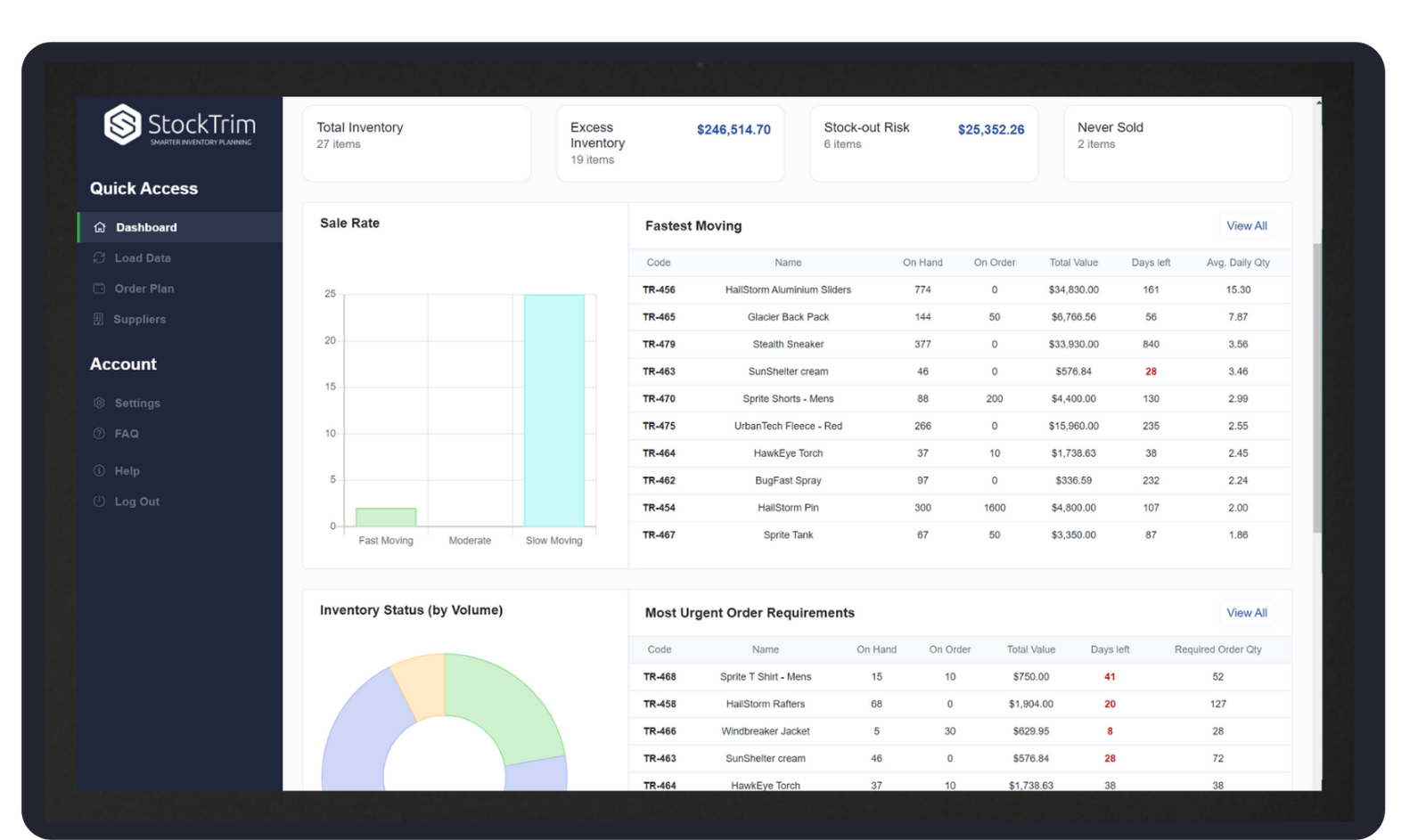
5. StockTrim — best for makers and manufacturers
Verdict: worth a trial, especially if you launch new products often. StockTrim is the quiet specialist here, built for small and mid-sized product businesses — apparel, food, manufacturing — and it does two things the Shopify apps don’t.
First, it forecasts new products with no sales history, using proxy data from similar items. Second, it forecasts up to 24 months ahead from up to 24 months of history, with automatic seasonality modelling. The raw-materials and multi-level BOM add-on (+$90/month) turns finished-goods forecasts into component orders.
Pricing is now revenue-tiered, starting from $49 a month on annual billing (per StockTrim’s own site); the $39/month Shopify plan that April 2026 articles quoted is gone. There’s a $299 onboarding fee and a 14-day trial.
Best for: apparel, food and manufacturing businesses with seasonal ranges, BOMs and frequent launches. Skip it if: you’re a pure Shopify reseller with no production — Prediko is simpler and cheaper.
6. Fabrikatör — best for pre-orders and backorders
Verdict: worth it if pre-orders are a real revenue stream; overkill if they’re not. Fabrikatör is a Shopify planning app with one clear superpower: it handles backorders and pre-orders properly.
It forecasts demand per SKU, builds purchase orders, plans bundles, and integrates with QuickBooks and Xero. Pricing is revenue-tiered: Seed $99 a month (or $79 a month billed annually) up to $500K, Scale-Up $149 up to $1.5M, Growth $199 up to $2.5M.
Two honest limits: it’s Shopify only, and its own FAQ says you need 50+ SKUs and six months of order history — a brand-new store gets rough forecasts. The 4.8/5 App Store rating (112 reviews) is solid.
Best for: Shopify brands between roughly $250K and $2.5M a year that sell bundles or take pre-orders. Skip it if: you don’t take pre-orders — Prediko covers the same forecasting ground for less.

7. GMDH Streamline — best for distributors outgrowing Excel
Verdict: only if you already run an ERP and test the free version first. Streamline is the value play of the ERP world: genuine statistical and AI forecasting, inventory optimisation and supply planning in one tool, with a free version you can download for Windows or Mac.
It connects to 22+ ERPs (NetSuite, Dynamics 365, SAP, QuickBooks) plus ODBC and API, and writes orders back to your ERP.
The catch is the price: there isn’t one published. The official pricing page just asks you to share details so a specialist can call you back. Paid plans are annual subscriptions, quoted per deployment — for distributors in the $10M+ revenue range, not a 200-SKU Shopify store.
Best for: SMB distributors and wholesalers on an ERP who want real forecasting without enterprise prices. Skip it if: you want a price on the page, or you don’t run an ERP.
What actually beats a spreadsheet? Run this 4-week test during your trial
No vendor will run a fair accuracy test for you — and I didn’t run one here, because a real test needs your sales history. Every tool above offers a 14-day trial, long enough to run this test yourself:
- Pick 10 SKUs — your five best sellers and five mid-range products.
- Build your spreadsheet forecast for the next four weeks: a 12-week moving average, adjusted for planned promotions.
- Let the tool forecast the same 10 SKUs for the same four weeks. Don’t override its numbers.
- Compare actual sales to both forecasts and average the absolute percentage error across the 10 SKUs. The lower number wins.
If the tool doesn’t beat your spreadsheet by at least 5 points, cancel the trial — it’s not earning its keep. Pair this with solid inventory management software and the forecast actually turns into orders.
Which tool fits your kind of shop?
| Your shop | Start with | Why |
|---|---|---|
| Shopify D2C brand, under $2M | Prediko | Cheapest real forecasting; built for Shopify |
| Shopify brand that takes pre-orders | Fabrikatör | Backorders and ship dates done properly |
| Selling on 2+ marketplaces | Sumtracker | One true stock count, forecasting on top |
| Multichannel, $1M+ catalogue | Inventory Planner | Open-to-buy planning across every channel |
| Maker / manufacturer, seasonal ranges | StockTrim | New-product forecasts, BOMs, 24-month horizon |
| Distributor on an ERP | Netstock or GMDH Streamline | Depth your ERP alone can’t give you |

Brick-and-mortar POS shops: none of these tools connects to Square or Lightspeed directly — your path is the ERP route (Netstock or Streamline) once you outgrow spreadsheets. This guide sits inside our wider roundup of the best AI tools for small ecommerce businesses.
FAQ
How accurate are AI demand forecasting tools?
It depends on your data, not the tool. With 12+ months of clean history, a good tool typically lands within 10–20% on stable SKUs. New products, promotions and stockouts widen the error — and any vendor claiming one accuracy number for every product is selling a slogan.
Can AI forecast demand for new products with no sales history?
Most can’t — they need history. StockTrim is the exception: it forecasts new SKUs from proxy data of similar items. Inventory Planner also offers new-SKU forecasts. Everyone else needs a few weeks of sales first.
Do I need an ERP to use demand forecasting software?
No. Prediko, Sumtracker, StockTrim and Fabrikatör work straight from Shopify or marketplaces. Only Netstock and GMDH Streamline need an ERP — and without one, they won’t work at all.
What’s the cheapest AI demand forecasting tool for a small business?
Prediko, from $49 a month ($42 billed annually) for Shopify stores under $100K in annual GMV. StockTrim starts at the same $49 a month on annual billing. Sumtracker’s forecasting starts at $119 a month — its $59 plan is sync only.
How much sales history does a forecasting tool need?
Two to three months minimum for anything useful, twelve months for seasonality. Fabrikatör’s FAQ recommends six months of order history. Starting a trial in November means the tool learns through your biggest sales weeks.
Can a forecasting tool handle seasonal products and holiday spikes?
Yes, if it has last year’s seasonal data — which is why starting before Black Friday matters. But no tool predicts a spike it has never seen: a product that goes viral in December will still catch it by surprise.
The verdict
If you sell on Shopify and nowhere else, start with Prediko — $49 a month, the strongest reviews, the lowest risk. Multichannel sellers should trial Sumtracker Replenish at $119. Makers and manufacturers, try StockTrim. Everyone else: match the tool to your shop type in the table above, and run the 4-week test before you pay for a second month. A tool that can’t beat your spreadsheet isn’t worth $49. For the other half of the job, see our guide to AI product description generators for small businesses. Read how we work.
Enjoying ToolsBizAI guides?
Add us as a Preferred Source on Google — you'll see our latest tools and guides first in Search, Top Stories, and AI Overviews.
Get One Useful AI Tool Tip Every Week
One practical AI tool tip in your inbox every week. No spam, unsubscribe anytime.

We’re the team behind ToolsBizAI. We hands-on test AI tools for small businesses — signing up for free plans, taking real screenshots, and fact-checking every claim before publishing. Our guides cover marketing, customer support, and day-to-day operations.