

TL;DR — the direct answer: The best AI phone answering service for small business is Goodcall if you want a turnkey AI receptionist ($79/mo), Rosie if you want the cheapest real option ($49/mo), or AnswerAmerica if you’d rather pay a human $1.47 a call. In this guide you’ll find: all 7 services compared with real October-2026 pricing, the per-minute and per-call billing traps that quietly double bills, setup-time reality checks, the legal rules for AI voices and call recording, and a 5-minute checklist for choosing yours.
This morning — literally this morning — a company called Jobholler announced a 24/7 AI receptionist built for HVAC, plumbing, electrical, and roofing contractors: from $85 a month, free 3-day trial (AB Newswire, October 20, 2026). New AI answering services are launching by the week now, and every one promises you’ll never miss a call again.
Here’s what the sales pages won’t tell you: missed calls are expensive, but the wrong answering service is expensive too. A per-minute plan that looks cheap at $99 a month can quietly become $600 when December doubles your call volume. An AI that can’t book into your calendar is just a polite voicemail. So I opened all seven of these services’ websites this week, ran their pricing math line by line, and compared what they actually do — not what the marketing copy says.
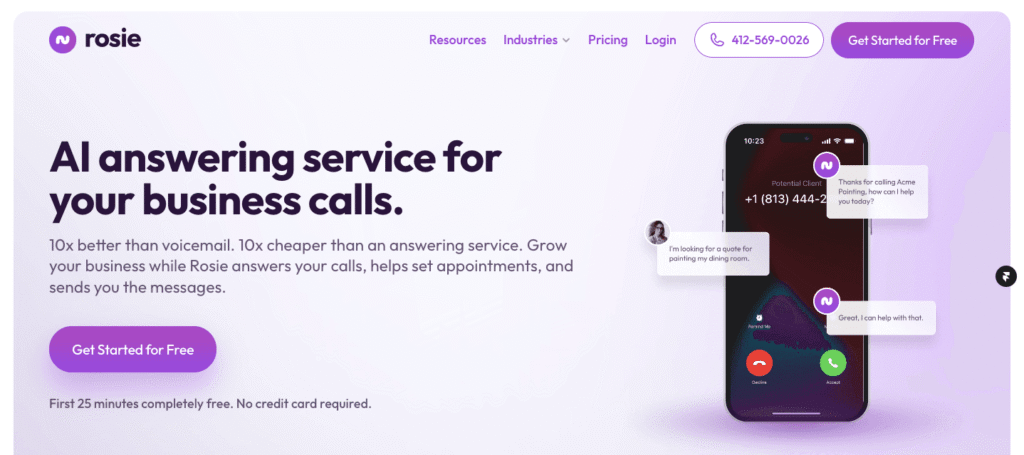
How we tested
Here’s exactly what I did — and what I didn’t.
What I did: I opened every vendor’s homepage, product pages, and pricing pages on October 20, 2026, and verified every price here against the official pages. I computed the real monthly cost at 100, 200, and 300 inbound calls, because headline prices lie and volume math doesn’t. I checked trial terms, setup-time claims, and which services disclose the AI to callers.
What I didn’t do: I didn’t place hundreds of graded test calls through each service. Nobody independent has — the only “240 test calls” claim I found came from a vendor testing itself. Where a pricing page hid a number (PATLive’s table renders in JavaScript; Ruby doesn’t publish its overage rate), I say so instead of guessing.
You can read more about our testing approach on our About page.
The short answer: which AI phone answering service for small business should you pick?
- Best all-rounder: Goodcall. Turnkey AI receptionist, no per-minute billing, from $79/mo. The most honest pricing in the category.
- Cheapest real AI: Rosie. $49/mo for 250 minutes. Catch: real calendar booking needs the $149 tier.
- Cheapest human: AnswerAmerica. $1.47 per answered call, no retainer, no contracts.
- Best hybrid (AI + humans): Smith.ai. AI answers first, escalates to live receptionists. Watch the per-call add-ons — they stack.
- Build it yourself: Bland AI. Cheapest AI voice minutes ($0.14), but it’s a developer platform. Skip it unless you have a tech person.
- Premium humans: Ruby ($395–$1,725/mo) and PATLive ($99–$759/mo). Excellent people, premium prices, per-minute metering that punishes long calls.
All 7 compared
| Service | Type | Real price (Oct 2026) | Billing model | Trial | Best for |
|---|---|---|---|---|---|
| Goodcall | AI, turnkey | $79–$299/mo | Per unique customer | Free demo agent | Most small businesses |
| Rosie | AI, turnkey | $49–$299/mo | Per minute | 7-day trial | Tightest budgets |
| Smith.ai | Hybrid AI + human | AI $150–$500/mo; live $810–$2,100/mo | Per call | AI free tier (25 calls/mo) | Need human backup |
| Bland AI | AI developer platform | ~$0.14/min + telephony | Per minute | Free test credits | Teams with a developer |
| AnswerAmerica | Human | $1.47/answered call | Per call, no retainer | None (pay per call) | Low call volumes |
| PATLive | Human | $99–$759/mo | Per minute | 14-day trial | 24/7 human coverage |
| Ruby | Human (+ free AI extras) | $250–$1,725/mo | Per minute | 21-day money-back | Premium image |
Two honest exclusions: Air AI advertises hard, but it’s enterprise software (reported $25,000–$100,000 upfront license, outbound-sales focus) — not a small-business answering service. VoiceNation was acquired by Moneypenny and no longer publishes standalone plans. I left both out rather than padding the list.
The 7 services, one by one
Goodcall — the one I’d recommend to most owners

Verdict: worth it. The most turnkey AI receptionist here, with refreshingly honest pricing.
Goodcall’s AI agent answers, qualifies leads, books into your calendar, and takes messages — 24/7, under your business name. Pricing is per unique customer, not per minute, and that’s the detail that matters: Starter is $79/mo for 100 unique customers (then 79¢ each), Growth is $129/mo for 500 (then 26¢ each), Scale is $299/mo for 2,000 (then 15¢ each). No per-minute charges, ever. You can build and test a demo agent free before connecting a number.
The trap: the “unique customer” cap. A caller from a new number counts as a new customer, so a business with lots of short first-time calls burns the cap faster than the headline suggests. At 100–300 inbound calls a month, most small businesses land at $79–$129.
Skip it if: you need SMS conversations with callers or a wide choice of AI voices.
Rosie — the cheapest real AI answering
Verdict: worth it on a budget, with one catch.
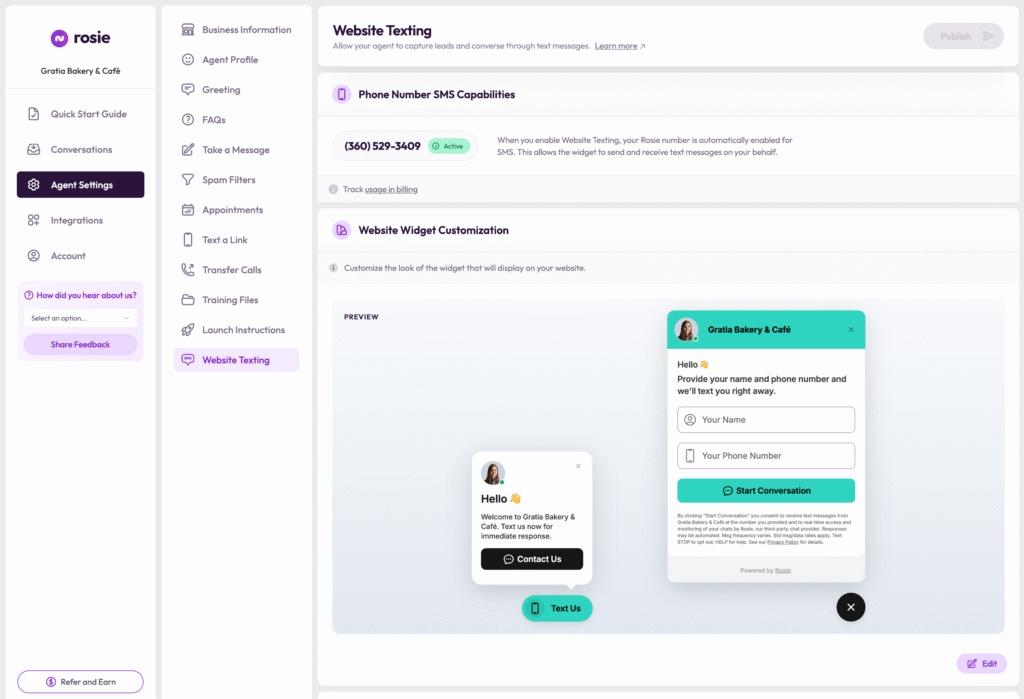
Rosie is the price leader: Professional is $49/mo for 250 minutes, Scale is $149/mo for 1,000 minutes with direct calendar booking, Growth is $299/mo for 2,000 minutes. It auto-trains on your Google Business Profile and website, speaks English and Spanish, and every plan includes summaries, transcripts, and recordings. 7-day free trial; annual billing saves two months.
The catch: the $49 plan only sends appointment links by text — for real appointment scheduling, the $149 tier is the one you want. Rosie also publishes no overage rate, so confirm what happens past your minutes during the trial. And it’s AI-only: no human fallback, just transfers to your staff.
Skip it if: you want a human safety net, or callers who speak other languages.
Smith.ai — the hybrid: AI first, humans on standby
Verdict: worth it if you need the safety net; pricey if you don’t.
The only service here that genuinely does both. The AI Receptionist answers first and escalates to live, North-America-based receptionists when a human is needed. AI pricing: free for 25 calls a month, then $150/mo (75 calls) up to $500/mo (300 calls). Live-receptionist plans run $810/mo (90 calls) to $2,100/mo (300 calls). Month-to-month, 30 days’ notice, no setup fees.
What I like: known spam numbers (Smith.ai claims 20 million+) are auto-filtered and don’t count toward your quota. What to watch: the per-call add-ons — booking at $1.50, SMS at $0.50 — apply to every call that month, not just the ones that use them. A $150 plan with booking on 300 calls is really $600. Do that math before toggling add-ons.
Skip it if: your calls are simple enough for a pure-AI service at a third of the price — or if your customers mostly message your website, where AI chatbots do the same job for less.
Bland AI — powerful, but it’s a toolkit, not a service
Verdict: skip unless you have a developer.
Bland AI has the cheapest AI voice minutes on paper — $0.14/min to start, $0.12/min on the $299/mo plan — with serious compliance credentials (SOC 2, HIPAA with a signed BAA). But Bland is a developer platform: someone has to build the phone agent, wire up telephony (billed separately), and maintain it.
For an owner who wants to stop missing calls this week, that’s the wrong product. For a business with a tech-savvy staffer, it’s the most flexible, cheapest-per-minute engine here.
Skip it if: “API documentation” makes your eyes glaze over.
AnswerAmerica — the simplest human option

Verdict: worth it for low call volumes.
Disarming in its simplicity: $1.47 per answered call. No retainer. No setup fees. No contracts. Their homepage does the math: 50 calls is $74/mo, 100 is $147, 200 is $294. US-based agents, 24/7/365, live about five minutes after signup.
The tradeoff is scope: message-taking and intake, not AI features — no calendar AI, no lead scoring, no integrations to speak of. But if your problem is “nobody picks up after 6pm,” a human answering for $1.47 a call is hard to argue with.
Skip it if: you need booking, CRM sync, or AI rather than a human taking messages.
PATLive — solid humans, watch the per-minute meter

Verdict: decent, but do the overage math first.
PATLive is 100% human — their FAQ says it outright: “We do not use bots or AI.” Plans run $99/mo (50 min), $189 (100 min), $349 (200 min), $759 (500 min), plus pay-as-you-go at $49/mo + $2.99/min. No contracts, no setup fees, 14-day trial, Spanish included.
The trap is per-minute metering. At $2.99 a minute on pay-as-you-go, one busy month can double your bill, and mid-plan overages run ~$1.99–$2.29/min. Long, chatty calls get expensive fast — a 15-minute “let me explain my situation” caller is real money. Fine for short calls; dangerous otherwise.
Skip it if: your callers talk at length, or you want any AI features.
Ruby — the premium human service
Verdict: excellent, expensive, honestly human.
The white-glove option: live US-based receptionists, 24/7, bilingual English/Spanish, scheduling, even payment collection, with 5,000+ integrations. Plans: $250/mo (50 min), $395 (100 min), $720 (200 min), $1,725 (500 min). No setup fees, and their “optional AI enhancements” are included free on every plan.
The catch: per-minute metering with an unpublished overage rate (third parties estimate $3.30–$5.90/min; Ruby doesn’t confirm it). On the $395 plan, a handful of long calls pushes you into overage territory fast. No free trial either — just a 21-day money-back guarantee.
Skip it if: your budget is under $400 a month, or most calls are simple enough for AI.
The new wave: trade-specific AI receptionists
Jobholler (launched October 20, 2026) is part of a pattern none of the big roundups cover yet: AI receptionists built for one trade. It targets HVAC, plumbing, electrical, and roofing — answering missed and after-hours calls under your business name, emailing a summary within minutes, keeping your existing number. From $85/mo with a 3-day trial. (Announced, not independently verified.)
Why it matters: a generic AI asks “how can I help you?” A trade-specific one knows the difference between “my AC died” and “I need a panel-upgrade quote” — and routes accordingly. Before buying generic, check for a vertical specialist in your trade: better intake, often lower pricing.
Setup time: what “live in minutes” actually means
Setup ranges from ~5 minutes (AnswerAmerica — just call forwarding) to minutes for Goodcall and Rosie (no-code builders, AI trained on your website), ~48 hours for Smith.ai’s human-escalation scripting and testing, and roughly a week for Ruby’s human team to learn your business. The more human the service, the longer the setup — a good sign; a live-receptionist service promising 5-minute setup should worry you. For AI services, budget an hour of test-calling to fix wrong answers before going live.
The legal bit: AI voices and recording laws
Three things to know before an AI answers your phones:
1. AI voices have legal status. In February 2024, the FCC ruled that AI-generated and cloned voices count as “artificial or prerecorded voice” under the Telephone Consumer Protection Act. The good news: that rule covers calls you place. Inbound calls — customers calling you — don’t trigger the consent requirement. (Source: dev.to/jyeg, October 2026.)
2. Disclose the AI anyway. The FCC proposed in August 2024 that callers must disclose AI use at the start of a call; as of October 2026 that rule still isn’t final. But the safe practice is having the AI identify itself in its first sentence. Goodcall does this by default — their FAQ says callers are told they’re speaking with an AI assistant.
3. Recording consent varies by state. Every service here records or transcribes calls. Twelve states require all-party consent: California, Connecticut, Delaware, Florida, Illinois, Maryland, Massachusetts, Montana, New Hampshire, Oregon, Pennsylvania, and Washington. The fix works everywhere: announce the recording at the start of every call. (Source: evecalls.com, 2026.)
Not legal advice — but “this call is answered by our AI assistant and may be recorded” as an opening line covers both fronts.
The 5-minute checklist: run this before you buy
- Price it at YOUR volume. Use your last three months of missed + after-hours calls, not the vendor’s example. Run the overage math — that’s the real price.
- Ask what a “call” or “minute” means. Rounded up to 60 seconds? Unique callers or total calls? One definition moves bills 30%+.
- Test the failure case. Call at 11pm Saturday with a weird question. What happens when the AI doesn’t know — human escalation, a message, or silence?
- Check calendar integration yourself. “Books appointments” can mean direct sync or a texted link. Different products.
- Ask about spam. Does the service filter robocalls, and do filtered calls count toward quota? (Smith.ai’s don’t. Ask the others.)
- Read the cancellation terms. Month-to-month with 30 days’ notice is the standard. Anything stricter needs a discount to match.
FAQ
- How much does an AI phone answering service for small business cost? $49–$299/mo for AI-first services, $147–$441 for pay-per-call human services like AnswerAmerica, $395–$1,725+ for premium humans like Ruby.
- Per-call vs. per-minute billing — what’s the difference? Per-call (AnswerAmerica, Smith.ai) is flat per answered call — predictable, friendly to long conversations. Per-minute (Ruby, PATLive, Rosie) meters talk time — cheaper for short calls, punishing for long ones.
- Can I keep my existing business number? Yes — every service here works by forwarding your existing number. It’s standard across the category.
- Do these services book appointments into my calendar? With caveats. Goodcall and Smith.ai’s AI offer booking; Rosie only books directly into your calendar on $149+ tiers (the $49 plan texts links). “Books appointments” is used loosely — verify which one it is.
- Are AI answering services HIPAA-compliant? Some: Bland AI offers HIPAA with a signed BAA (but it’s a developer platform); AnswerAmerica advertises HIPAA compliance for its human agents. Get the BAA in writing — a marketing badge isn’t an agreement.
- Will customers mind talking to an AI? Some will, most won’t — if it solves their problem fast. What customers hate is voicemail and hold music. An AI that answers in two rings and gets them a callback beats a human on ring twelve. Disclosing the AI upfront (Goodcall does this by default) keeps complaints down.
The bottom line
If I were opening a small business tomorrow and missing calls was costing me jobs, I’d start with Goodcall’s $79 plan — the closest thing to a solved problem here: real AI, honest pricing, no per-minute anxiety. On a tighter budget, Rosie’s $49 plan gets you in the door. And if you’d sleep better with a human answering, AnswerAmerica at $1.47 a call is the simplest money you’ll spend.
Whatever you pick: run the overage math, test the 11pm weird-question call, and make the AI introduce itself. The technology is the easy part — the billing fine print is where small businesses lose money.
Prices checked October 20, 2026 — every figure comes from the vendor’s own site (PATLive’s pricing table renders in JavaScript, so those numbers are confirmed via current reads of their official page). Check the vendor’s pricing page before you buy.
Enjoying ToolsBizAI guides?
Add us as a Preferred Source on Google — you'll see our latest tools and guides first in Search, Top Stories, and AI Overviews.
Figure out your real monthly bill before you fall for the sticker price
Every AI answering service advertises its cheapest plan and hopes you never do the math. Do it anyway — it takes four minutes. The average small-business call runs about 2.5 minutes, so 150 calls a month is roughly 375 minutes. That’s your yardstick.
Billing models differ, and the model matters more than the price. Per-minute plans (Dialzara) punish long calls; per-call plans (Upfirst) punish volume; Goodcall prices by unique caller — $79/month for 100 unique callers with unlimited minutes (per aijourn.com, prices checked Oct 2026). If your callers are repeat customers who love to chat, unlimited minutes can quietly beat a cheaper per-minute plan.
Now run the yardstick. Marlie’s $99 Standard includes 500 minutes — 375 minutes costs $99 flat. Dialzara’s $29 Lite gives you 60 minutes; the other 315 minutes at the $0.48 overage rate comes to about $180 a month. Upfirst’s $59.95 Premium covers 90 calls — and per-call billing passes $100 a month at roughly 130 calls.
Watch the feature-strip trap too. Rosie’s $49 plan gives you 250 minutes but no calendar booking or live transfers — those live on the $149 plan. A receptionist that can’t book is voicemail with better branding.
My checklist before paying anything: (1) does it book into your calendar, or only text you a booking link; (2) can it transfer an urgent caller to you live; (3) what does your busiest month cost. Then run the free trial on real calls — a booking request, an urgent caller, and one question your website doesn’t answer.
(Source read: aijourn.com/8-best-ai-answering-services-under-100-a-month-in-2026/, prices checked Oct 2026.)
Get One Useful AI Tool Tip Every Week
One practical AI tool tip in your inbox every week. No spam, unsubscribe anytime.

We’re the team behind ToolsBizAI. We hands-on test AI tools for small businesses — signing up for free plans, taking real screenshots, and fact-checking every claim before publishing. Our guides cover marketing, customer support, and day-to-day operations.